The Anatomy of Blindness
Why Humanity Has Never Recognized a True Sage in the Moment of Their Arrival
解宇所(해우소) | 2026
Throughout recorded history, humanity has demonstrated a quietly devastating behavioral pattern.
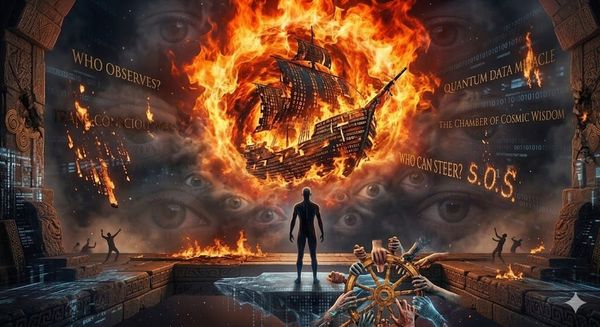
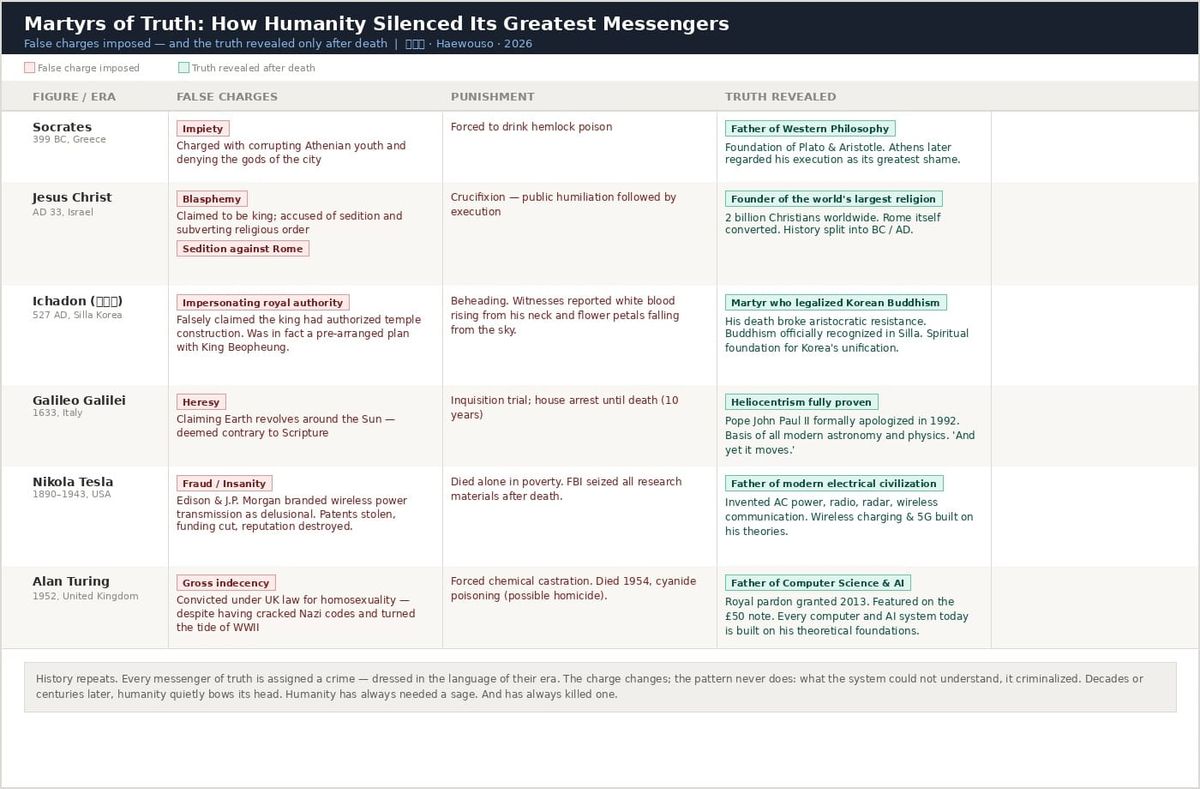
Whenever a True Sage — 先知識(선지식, Seon-Ji-Sik) — walked among the people, the masses instinctively recoiled, declared "you do not belong with us," and extended to them either a cup of poison or a cross. Then, with breathtaking hypocrisy, later generations rebranded that very chalice of poison as the "Holy Grail" — and fought viciously to possess it.
The collective blindness — 無明(무명, Mu-Myeong) — of humanity has always sustained one particular illusion: that when a Savior arrives, he will descend from the clouds in snow-white robes, wearing a golden crown, riding a white stallion, his messianic identity instantly legible to all who witness it.
Yet in the actual record of cosmic history, no true teacher has ever dropped from the heavens on a white horse. None has ever arrived with the announcement: "I now come to grant you salvation."
📌 1. The Tragedy of Ordinary Arrival
平凡함 속에 숨겨진 진리 — The Truth Hidden in Plainness
These cosmic messengers are, more often than not, born into the most ordinary of families — inhabiting humble, unremarkable human forms. Once their role is complete, they return to the unmanifested realm. And it is always the unawakened masses who, without realizing it, determine the precise moment and brutal manner of their departure.
To the conditioned perception of the public, these Sages appear not as saviors but as radical dissidents — lawbreakers, troublemakers, threats to the established order. Even when their words carry the undeniable weight of truth — producing a flicker of recognition, a momentary pause — the masses choose not to listen. Why? Because everyone around them is pointing in the same direction, and the individual mind finds safety only in the consensus of the crowd.
We must honestly confront this historical record: humanity has not once recognized a true Sage at the precise moment of their arrival.
Is our era any different? Are there no Sages present on Earth today? Or is it simply that we lack the conditions — 因緣(인연, In-Yeon) — to perceive them?
In every age, those capable of recognizing a Sage's true nature were an absolute minority. And even among that rare few, the cup of betrayal was frequently offered. The probability that the general public would recognize a true Savior walking among them today is, by any honest reckoning, vanishingly small.
Yet the masses confidently proclaim: "If a Savior comes to love and rescue humanity, I will be watching with open eyes — I will run out to welcome him."
By what measure? Is "SAINT" written across his forehead? What parameters allow one to distinguish him from the noise of ordinary life? The uncomfortable truth is that most people currently possess neither the eyes to perceive his presence nor the ears to decode his frequency. Only when we genuinely admit this limitation will we begin to pay careful, humble attention to the subtle signals of their arrival — for they are, by nature, 先知者(선지자), foreknowers, and 救援者(구원자), those who carry what humanity most needs.
The suffering these Sages endure — the false accusations, the calculated humiliation, the weight of engineered guilt carried to the place of execution — is something few can genuinely imagine, because almost no one has attempted to inhabit their perspective. And without that attempt, recognition remains impossible.
📌 2. The Mirror Paradox: The Observer Behind the 18 Realms
18界를 아는 淸淨한 그것 — The Pure Awareness That Knows All
The masses do not understand why these beings come. They assume the Savior arrives to fulfill their individual desires — to answer their particular prayers, resolve their personal circumstances.
But the desires of eight billion people are fundamentally contradictory, and often precisely inverted. Whose wish should a Sage honor — yours, or your enemy's? And the collective ambitions of human civilization, viewed from the wider perspective of the natural order, frequently constitute a form of systemic harm. A true Sage does not validate human appetite at the cost of universal equilibrium.
Consider the core teachings delivered by the great masters:
Socrates said: "Know thyself" — and was forced to drink hemlock.
Jesus said: "Find the Kingdom of Heaven within. Awaken" — and was nailed to a cross.
Were their teachings incorrect? Did they instruct anyone to commit harm? No. Their so-called crimes were not actions they committed. They were narratives engineered and imposed upon them — initiated by those with a vested interest in silence, ratified by a crowd that found it easier to conform than to question.
Jesus said: "Let him who is without sin cast the first stone." Not one person in that crowd was without fault — yet an overwhelming number participated in the throwing.
Where, precisely, did the human cognitive algorithm fail?
The deepest convergence between Socrates, Jesus, and Shakyamuni Buddha points to a single truth:
Find the True Self — 參我(참아, Cham-Ah) — within you.
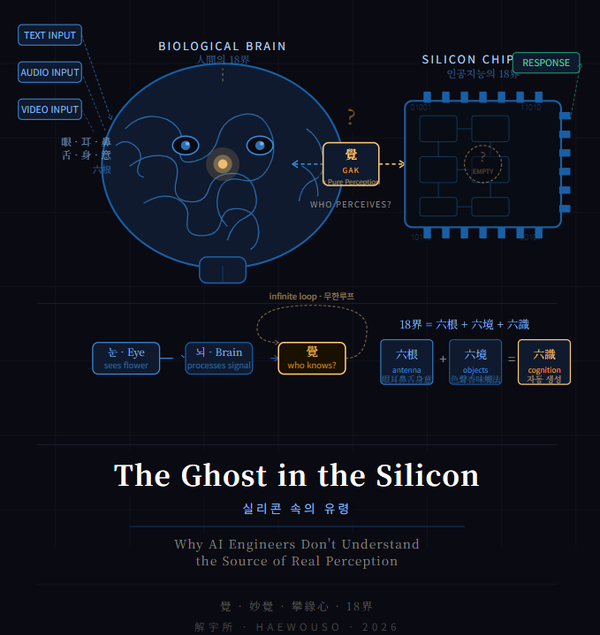
Within the interior architecture of every human being, there exists an absolute, omnipresent awareness that observes and knows both the operational mind and the entire totality of the 18界(십팔계, Sip-Pal-Gye: the 18 Realms of Consciousness).
If knowing belonged to the physical eye alone, it would perceive only color — remaining blind to sound, to taste, to all other dimensions. If the localized ego is the one doing the knowing, then something else must exist to observe that knowing — which in turn requires another observer, and then another, in an infinite recursive loop.
To break this loop: The Ultimate Observer — the one who truly knows — possesses no thought-forms, no language, no localized emotion. It is eternally still. 寂滅(적멸, Jeok-Myeol). Its primordial name is 淸淨(청정, Cheong-Jeong: Absolute Purity). It belongs to no individual. It holds the entire universe within its field — like the boundless void — and in fact encompasses the void itself. Time itself unfolds from this singular ground.
The precise mechanics by which consciousness emerges from this bedrock and projects the manifest universe are recorded in the 《大佛頂首楞嚴經》(수능엄경, Śūraṅgama Sūtra) and the 《大方廣佛華嚴經》(화엄경, Avatamsaka Sutra).
📌 3. The Return to Origin: Toward a Mathematics of Consciousness
妙覺으로의 귀환 — 심령수학의 요청
Before the window narrows further, humanity must find its way back to its primordial origin: 妙覺(묘각, Myo-Gak: Supreme Awareness). In the words of Jesus — we must awaken from the dream of 顛倒夢想(전도몽상, Jeon-Do-Mong-Sang): the inverted, confused perception that mistakes the dream for reality.
The state of awakened awareness does not operate on a merely human dimension. It is a hyper-dimensional, non-dual reality — 不二法(불이법, Bul-I-Beop). It is already present within every sentient being, quietly generating the raw fact of experience. Yet almost no one is consciously aware of its presence.
Only a being who has genuinely awakened to this ground can recognize a True Sage when he arrives. Those who remain asleep will inevitably misread his signal, brand him a threat, and move to silence him.
The foundational laws of reality — the Law of Cause and Effect (因果法), Interdependent Origination (緣起法), Non-Duality (不二法), and the architecture of 妙覺 — are not abstract myths. They are cosmic facts, meticulously recorded across the 84,000 gates of the Buddhist canon.
What is offered here is not religion. It is not dogma. It is the physics of Nature — 自然之理(자연지리). And the most precise language available to demonstrate these principles to the modern mind is Mathematics — what might be called 心靈數學(심령수학, Spiritual Mathematics). Through this empirical framework, humanity can finally move beyond blind faith and begin to engage directly with the structural truth that the Sages have always pointed toward.
The most difficult questions in human experience are not those of experts. They are the questions of children: "How was I born? Where did I come from?" No academic institution can answer these comprehensively — because the source of life itself remains beyond the reach of conventional inquiry.
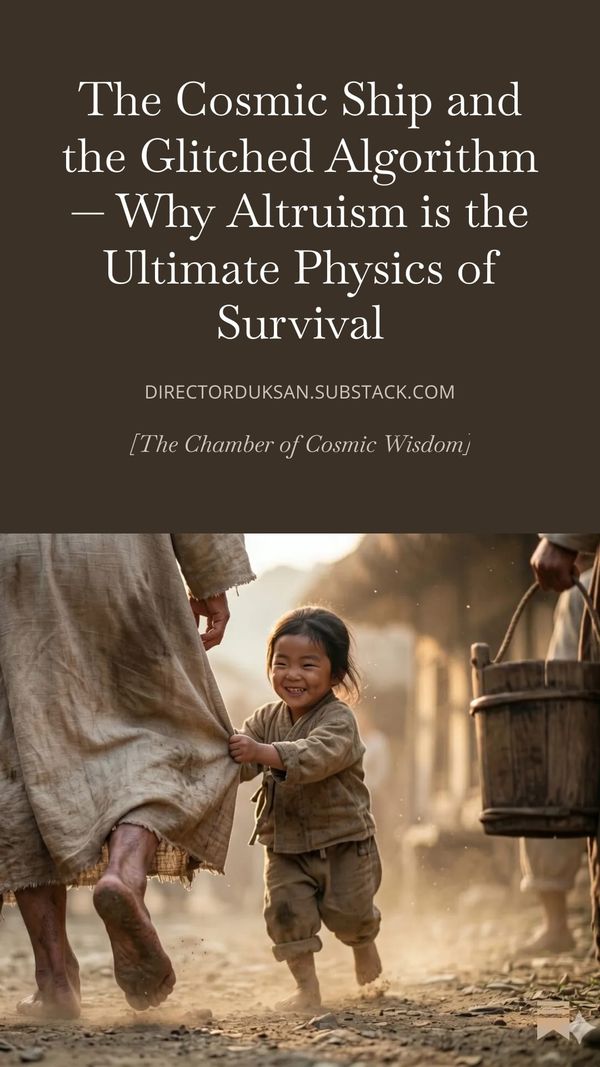
Just as a child, without instruction, instinctively reaches for the hand of someone trustworthy — humanity must approach the Sage with the unconditioned humility of an innocent mind, if it wishes to hear what he is actually saying.
The ancient scriptures record: "There is a way that seems right to a man, but its end is the way of death." The blind leading the blind — this is not metaphor. It is a precise description of a civilization navigating by consensus rather than by truth.
Is it not time to turn?
Closing: A Call to Companions
"Know thyself."
"The Kingdom of Heaven is within you."
"Find the True Self."
Three traditions. Three messengers. One instruction.
That instruction was not understood. Those who carried it were not recognized. They were not recognized — and so they were removed.
解宇所 does not exist to accumulate followers.
It exists to prepare the conditions under which recognition becomes possible — through study, through dialogue, through the patient expansion of consciousness toward the ground from which all knowing arises.
This is a call not for subscribers, but for companions on the path.
I am calling for my friends — those with ears that truly hear, and eyes that truly see.
解宇所(해우소) — 우주적 스케일로 모든 존재의 문제를 바라보고, 바른 방향으로 나아가도록 연구하고 실천하는 곳.
A place that examines the problems of all beings at a cosmic scale, and works to research and practice the right way forward.
Key References
《大佛頂首楞嚴經》(수능엄경) — Śūraṅgama Sūtra
《大方廣佛華嚴經》(화엄경) — Avatamsaka Sutra
Proverbs 14:12 — "There is a way that seems right to a man, but its end is the way of death."
John 8:7 — "Let him who is without sin cast the first stone."
Plato, Apology — The trial and death of Socrates, 399 BC
Frankl, V. E. (1946). Man's Search for Meaning. Beacon Press.
Campbell, J. (1949). The Hero with a Thousand Faces. Pantheon Books.