We Are on a Burning Ship and Nobody Is Steering
A Scientific Case for Conscience — and a Call to the Noble Minds Who Still Care
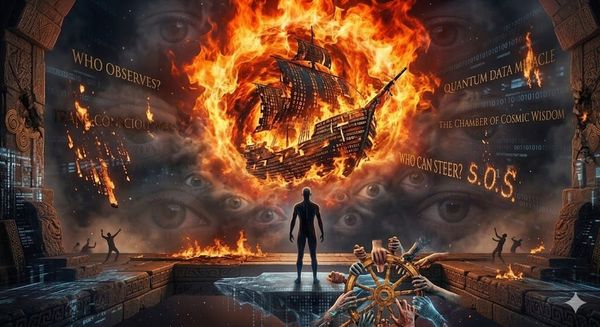
The Cosmic Ship and the Glitched Algorithm
— Why Altruism is the Ultimate Physics of Survival
解宇所 (Haewouso) | Inaugural Issue | 2026
解宇所 — A place that examines the problems we all face at a cosmic scale, and researches the path forward for the benefit of all beings.
Prologue: Look Out the Window
Look out the window.
We are currently aboard a single organic spacecraft called Earth, hurtling through the pitch-black void of space at 30 kilometers per second. There is no backup planet. There is no escape hatch.
Now look at the passengers.
Down in the lower decks, they are firing missiles at each other, burning through resources, shedding blood — bragging about who is more violent. They treat this fragile capsule as though they will live forever, completely blind to the fact that their survival probability is mathematically collapsing.
In an era when Artificial Intelligence and the digital matrix have completely dissolved the barriers of language and nation, this primitive, tribal violence is not merely immoral. It is a catastrophic system error.
It is time to run a cold, hard, scientific diagnostic on human consciousness.
Chapter 1. The Thermodynamics of Karma: The Physical Cost of Malice
In modern systems physics, any action that injects chaos, destruction, or division into a closed system is defined as increasing entropy — the measure of disorder.
When you act from malice, greed, or violence, you are injecting high-entropy noise into the collective human network. By the absolute law of action and reaction — Newton’s Third Law — and the conservation of cosmic information, that system-wide chaos must loop back to its source. This is the physical reality of karma.
Neuroscience confirms this at the biological level. A brain operating under malicious intent fires the amygdala relentlessly, flooding this biological supercomputer with cortisol and adrenaline. This chronic biochemical glitch literally destroys neural architecture, degrades cellular DNA, and collapses the immune system. The brain remembers every betrayal of conscience — and the body pays the debt.
Conversely, Gong-Deok-Seong (공덕성, 功德性) — the deliberate accumulation of pure altruism — is the intentional injection of negative entropy into the system: order, harmony, coherence. Acting with conscience and treating others as friends reduces systemic noise, triggering immediate stabilization within your own biology. The brain’s reward circuit — the nucleus accumbens — activates in what is known as the “helper’s high.” Doing good is not a moral obligation; it is a neurological pleasure.
Conscience is not a moral suggestion. It is the most rational biological optimization strategy available to the human organism.
Chapter 2. The Bragging Rights of Violence — Humanity’s Worst System Glitch
The world is currently suffocating under critical, existential system bugs.
Severe food shortages. Toxic pollution. Mountains of unmanaged waste. Cybercrime. Untreatable pandemics. Economic famine. The WHO projects that by 2050, antimicrobial-resistant bacteria will kill ten million people annually — a figure that rivals current global cancer deaths. Sea levels are rising. Topsoil is vanishing. Microplastics have already been found in the human brain.
Yet the world’s leaders ignore these critical errors.
Instead, they scream: “Look at me! I am the most violent predator in the room! If anyone is more violent than me — step forward!”
This is a pathetic spectacle. Why do they obsess over violence rather than systemic resolution?
Because their consciousness is trapped in the lowest, most primitive animal subroutine — the reptilian survival circuit. They mistake the instrument of destruction for power. They build bigger missiles to flex their egos while the very ship they ride is burning.
It is like the passengers of the Titanic brawling between first class and steerage while the bow disappears beneath the ice. Incomprehensible. An utterly baffling species.
But we cannot stop at outrage. Once the diagnosis is made, a prescription must follow.
Chapter 3. The Manifesto of 解宇所: Entering the Trans-Consciousness
This is precisely why 解宇所 (Haewouso) has established its perimeter.
The name derives from the Chinese characters 解宇所 — “the place (所) that decodes (解) the cosmos (宇).” We do not concern ourselves with humanity alone. Our mandate is to identify solutions that benefit all beings on this planet.
We are not a temple of comforting words. We are a research and execution chamber, built around three core missions:
① Dismantling and Decoding Consciousness We excavate the true nature of inner human consciousness. We confront directly the source code that governs our behavior — why we act as we do, and what subroutines hold us captive.
② Expanding into Trans-Consciousness We move beyond current cognitive limitations into Trans-Consciousness (초의식, 超意識). As neuroscientist Andrew Newberg observed, in states of deep compassion, activity in the parietal lobe — the region of the brain that constructs the boundary between self and other — falls dramatically. When the boundary dissolves, the suffering of another becomes your own. This is why the bodhisattva’s compassion is not mysticism. It is the high-dimensional operating mode of consciousness itself.
③ Solving Humanity’s Most Urgent Crises We convene with the noble, high-level minds of this planet to design real, scalable solutions for food scarcity, pollution, disease, and crime. We put our heads together — because the problems demand it.
Our ultimate objective: to restore this damaged ecosystem and hand a pristine, beautiful planet to our successors — the Neo-Humans (신인류, 新人類) who will carry the torch forward.
Chapter 4. The Door the Digital Revolution Has Blown Open
The emergence of AI and the digital world is the most powerful act of barrier demolition in human history.
Language walls have fallen. Borders tremble. A young person in Seoul and a young person in Lagos share the same memes, listen to the same music, carry the same anxieties. In an age when a Ukrainian mother and a Russian mother post photos of their children on the same platform, what exactly does the phrase “enemy nation’s citizen” mean?
The implication is profound. For the first time, humanity possesses the technological conditions for the entire species to communicate in real time. To continue primitive tribal warfare under these conditions is not merely foolish — it is an act of deliberate self-destruction.
As economist Robert Putnam demonstrated through twenty years of tracking research, the single most powerful variable determining social progress is neither capital, nor technology, nor law — it is social trust. High-trust societies channel their energy into creation rather than defense. Gong-Deok — moral merit — is not a deposit for the afterlife. It is social capital, redeemable in the present.
The cost of a single nuclear warhead could fund clean water access across the African continent for a decade. Before it is evil, this is simply catastrophically inefficient management.
Conclusion: Upgrade Your Operating System
If you possess a brilliant mind, and your inner code resonates with this altruistic frequency — you are the ally we are looking for.
Exit the primitive, glitched simulation of war and dominance. Join 解宇所. Upgrade your operating system.
Let us stop wasting intelligence and resources on missiles aimed at each other. Let us fight the real enemy — climate collapse, food crisis, disease, pollution. Let us console one another, become friends, practice consideration, and put our heads together.
Let us build — together — a beautiful Earth to hand to the Neo-Humans who come after us.
We are on the same ship. No one knows where it is headed. Then at the very least — should we not row together?
解宇所 (Haewouso) — A place that examines the problems facing all beings at a cosmic scale, and works to research and practice the right way forward. We await the company of noble minds.
Key References Putnam, R. D. (2000). Bowling Alone. Simon & Schuster. Newberg, A. & Waldman, M. R. (2009). How God Changes Your Brain. Ballantine Books. Sapolsky, R. M. (2017). Behave: The Biology of Humans at Our Best and Worst. Penguin Press. WHO Antimicrobial Resistance Global Report (2022). IPCC Sixth Assessment Report (2021).